Recall When you find the vertical asymptote of a graph you factor out the original equation that you are given. If anything from the top and bottom cancels out, then what is canceled out is your hole. Moving on, whether something is canceled out or not, whatever is left as your denominator will be set equal to zero in order to find the x=# of the vertical asymptote. Then you set the limit equation. If you do have a hole then you set those factored parts of the original equation set to 0 to find what x equals. From here you plug in the number you got into the equation that remained from your polynomial after everything had been canceled out, and solve. For example: x^3-x/x^3+x^2-2x
when factored it is :
This makes the remaining equation the equation you will refer to when finding the vertical asymptote.
> vertical asymptote: (x+1)/(x+2) *now nothing cancels
> x+2 = 0 * set the denominator to zero
> x=-2 *once solved you get this as the equation for you vertical asymptote.
>hole: x=o *x was canceled out, set it to zero
> x+1=0 *solve ---> x=-1
^ 0 and -1 are you hole x-values so you set it in coordinates as > (0, ?) and (-1,?)
*now in order to solve for the y values you plug in the x values into the remaining equation
> (0+1)/(0+2) = 1/2 so it is now (0 , 1/2)
> (1+1)/(1+2)= 2/3 so it is now (1 , 2/3)
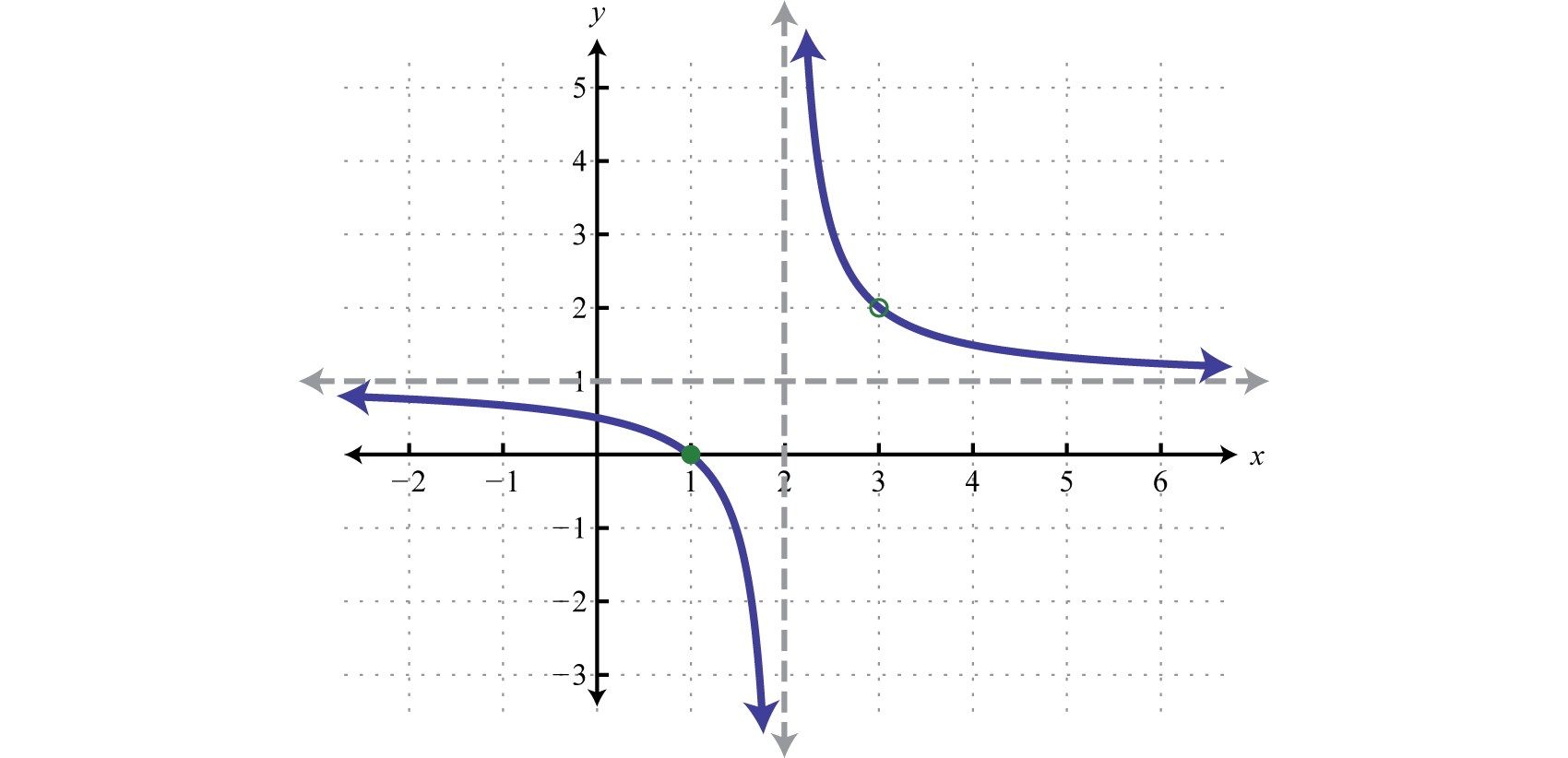
Now on that now, the difference between having a vertical asymptote and a graph having a hole is that a vertical asymptote is basically the line(s) that goes down the graph from top to bottom and crosses the x-axis---> hence it is VERTICAL, where as the holes on the graph are where the graph will not go through and are shown on the graph with open circles.

No comments:
Post a Comment