Create your own Playlist on MentorMob!
Wednesday, December 12, 2012

Sunday, December 9, 2012
Tuesday, November 27, 2012
Sunday, November 25, 2012
Thursday, November 22, 2012
Unit K. Fibonacci Haiku 2
Life's Mary-Go-Round

Memories.
Regret.
The journey!
It's a puzzle.
All can fall into place.
It's never as simple as black and white.

Unit K. Fibonacci Haiku 1

Nail Polish
Paint.
Nails.
Nail polish.
The smell penetrates.
Layout of hues and pigments.
An array of colors artfully cover my fingertips.
Sunday, November 4, 2012
Thursday, November 1, 2012
Thursday, October 18, 2012
Monday, October 15, 2012
Monday, October 8, 2012
Student Video #3: Unit H. Concept 7
- What is this video about?
- This video goes over how to find logs with given approximations/clues.
- What does the viewer need to pay special attention to in order to understand the concept?
- Remember the properties of expanding logs. [* Product Law: you break the logs apart and add them separately. *Quotient Law: You separate the terms of the log by subtracting them. * Power Law: you bring the power that is raised to the front of the log.] Also, note that if the base is the same as the answer, the exponent is 1 ---> logbb=1
Saturday, October 6, 2012
Thursday, September 27, 2012
Unit G Summary Question #10: Rang of a Rational Function.....
10. While the domain of a rational function depends on DIVAH, what do you think the range of a rational function depends on. Give an example.
NOTE: D-omain
I-s the
V-ertical
A-asymptote & the
H-ole

NOTE: D-omain
I-s the
V-ertical
A-asymptote & the
H-ole
I believe that range of a rational function is dependent upon all of the y-values that belong to the x-values that come from the vertical asymptotes and holes. For example, the vertical asyptotes for a graph were to be x=-2 and x=2 and the hole would be x=1. This would make the the domain, or the bad values, -2,2, and 1. With that, the range would be the infinite numbers that these numbers passed from +infinity (the + numbers of the y-axis) and - infinity (the - numbers of the y-axis). Because the lines run vertically downwards, the coordinate pairs would be something like (-2,4), (-2,3), (-2,2) ,(-2,1) ,(-2,0) ,(-2,-1) ,(-2,-2), (-2,-3) and so on upwards and down the y-axis, with the domain staying the same. This would be the same for the x=2 vertical asymptote. In short, the range would be ALL REAL NUMBERS. With that, the range of a hole would simply be the y-value. For exapmle, the hole would have the cordinates of (1, -1/2), -1/2 would be the range.
 |
| As you can see in this image, the vertical asymptote is x=-1. The range, or y-values, run up and down make it ALL REAL NUMBERS. |
On the other hand, if the y-value was a horizontal asymptote, the line would run straight across the y-axis and so it would NOT be all real numbers. For example, if y=2, the y-value would remain constant whereas you x-value would be constantly changing as you traveled across the graph from left to right. [(1,2),(2,2),(3,2),(4,2),(5,2), etc.,...] thus, the range of a horizontal asymptote would simply be the value of y. We have already been taking notice of this and it is noted in our limit notation. (If needed: Review the lesson in Unit G Summary Question #2).
Unit G SUmmary Question # 9: X-Intercepts of a Rational Function
9. Describe how to find the x-intercepts of a rational function. Include both the long way and the shortcut way, explaining why the shortcut makes mathematical sense.
How to: The LOOOOONG WAY....
In order to find the x-intercepts through the use of the faster method, it is important that you know how we got to that point and why.
To make it easier, lets use an example: 3x+3/x^2-4
^* REMEBER TO FACTOR!---> 3(x+1)/(x+2)(x-2)
* now we get to the fun part..... x-intercepts!!! :D
First: set the y [or f(x) ] to zero, thus setting the equation to zero
^ 0= 3(x+1)/(x+2)(x-2)
Second: Mulitply both sides by the denominator
^ (x+2)(x-2) 0=3(x+1)/(x+2)(x-2) x (x+2)(x-2)
Third: As you can see, the denominator cancels out on the right side
^ (x+2)(x-2) 0=3(x+1)/(x+2)(x-2) x (x+2)(x-2)
(x+2)(x-2) 0=3(x+1)
Fourth: as you can see, the (x+2)(x-2) will be eliminate becauseANYTHING multiplied by zeor will turn to...... zero!
Fifth: Now you have:
0=3(x+1)
Sixth: divide by 3:
0=3(x+1)
3 3
0-1=x+1 -1
Eighth!!! And your x-intercept is.... x=-1 making it (-1,0)
How to: SHORT WAY...
Phew! Now that you know how to do it the long way, the shorcut will make a lot of sense! :)
3 3

How to: The LOOOOONG WAY....
In order to find the x-intercepts through the use of the faster method, it is important that you know how we got to that point and why.
To make it easier, lets use an example: 3x+3/x^2-4
^* REMEBER TO FACTOR!---> 3(x+1)/(x+2)(x-2)
* now we get to the fun part..... x-intercepts!!! :D
First: set the y [or f(x) ] to zero, thus setting the equation to zero
^ 0= 3(x+1)/(x+2)(x-2)
Second: Mulitply both sides by the denominator
^ (x+2)(x-2) 0=3(x+1)/(x+2)(x-2) x (x+2)(x-2)
Third: As you can see, the denominator cancels out on the right side
^ (x+2)(x-2) 0=3(x+1)/
(x+2)(x-2) 0=3(x+1)
Fourth: as you can see, the (x+2)(x-2) will be eliminate becauseANYTHING multiplied by zeor will turn to...... zero!
Fifth: Now you have:
0=3(x+1)
Sixth: divide by 3:
0=
0-1=x+1 -1
Eighth!!! And your x-intercept is.... x=-1 making it (-1,0)
How to: SHORT WAY...
Phew! Now that you know how to do it the long way, the shorcut will make a lot of sense! :)
First: set the y [or f(x) ] to zero, thus setting the equation to zero
^ 0= 3(x+1)/(x+2)(x-2)
Second: since you know that the denominator will always cancel and be eliminated you can keep on moving forward. SIGH OF RELIEF....
0= 3(x+1)/(x+2)(x-2)
Third: You are left with...
0=3(x+1)
Fourth: divide by 3:
0=3(x+1)
Fifth: solve like you normally would.... in this case subtract 1 to both sides
0-1=x+1 -1
Sixth!!! And your x-intercept is.... x=-1 making it (-1,0)
Unit G Summary Question #6: Plotting Holes
6. How do we find the appropriate place to plot a hole if the y-value is undefined when plugged into the original equation?
NOTE: If you need to review how to find a hole, refer to Unit G Summary Question #4 :)
* Hopefully you noted that you only have a hole if the something that was the same on the top and bottom was canceled.
* Holes are in place of a regular point due to the fact that the denominator (value on the bottom of the fraction) cannot be equal to zero.
NOTE: If you need to review how to find a hole, refer to Unit G Summary Question #4 :)
* Hopefully you noted that you only have a hole if the something that was the same on the top and bottom was canceled.
* Holes are in place of a regular point due to the fact that the denominator (value on the bottom of the fraction) cannot be equal to zero.
 |
| Notice how the hole is like a break in the graph, but the graph continues after skipping the spot where the hole was plotted. As a result, the whole is NOT included within your answer. It also acts as a bad value thus it is annotated in your domain of a graph. After finding the x-value of the hole from the original equation and you plug it back into the original equation, you will get the answer as being undefined. In order to find the y-value CORRECTLY, you will have to plug that x-value into wherever the 'x' shows up in your simplified equation. This will give you your y-value and thus your coordinates of the hole. When finding the y-value of the hole, if it is undefined then that basically means that the hole is NOT included within your answer. When plotting the hole, make sure that you do so with an OPEN circle -∘- (not a just a regular point ⋅). |
Tuesday, September 25, 2012
Unit G Summary Question #8: Y-Intercepts
8. How do you find the y-intercept of a rational function? Does this need to be done in the original or simplified equation?
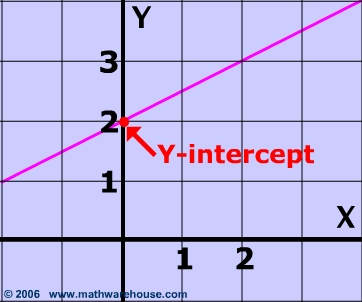 When finding the y-intercept of a rational function you simply plug in zeroes in the equation wherever there would normally be an 'x'. Froms here you solve normally. For example, if the equation was y= x^2+3x+/3x+1 you would plug in the 0's so that it would look like
y=(0)^2+3(0)+1/3(0)+1---> y=1/1 or y=1, thus the y-intercept would be (0,1).
You MUST note that if your graph did have holes and you canceled things out from the top and bottom (if you need review refer to Unit G Summary Question #4) it is mandatory that in order to find the y-intercept that you use the simplified/remaining equation.
Also, remember that a graph of a rational function can only have ONE y-intercept or NONE, but never more than one!
y=(0)^2+3(0)+1/3(0)+1---> y=1/1 or y=1, thus the y-intercept would be (0,1).
You MUST note that if your graph did have holes and you canceled things out from the top and bottom (if you need review refer to Unit G Summary Question #4) it is mandatory that in order to find the y-intercept that you use the simplified/remaining equation.
Also, remember that a graph of a rational function can only have ONE y-intercept or NONE, but never more than one!
Unit G Summary Question #7: Vertical Asymptote Limit Notation
#7: Describe how to write the limit notation for vertical asymptotes and what the notation means.
 Once you have found the vertical asymptote(s) [go back to Unit G Summary Question #4], you include those values in your limit notation. Make sure to graph the equation on your graphing calculator and because you will be using it to find the notation.
PLEASE NOTE: - sign on the right of the number means it is to the left of the vertical asymptote [ex. 2-] it does NOT mean its a negative, if it were if would look like -2 -. A + sign on the right of the number means it is on the right of the vertical asymptote. [ex. 2+] Also, recall that a + ∞ symbol means that the graph is going upwards and that a - ∞ symbol means that the graph is going downwards.
Lets use this picture as an example. As you can see, the vertical asymptotes are located where x=-1 and where x=1. Now you look the the left of the -1 vertical asymptote line and you see that the graph is going upwards. This is notated as follows: as x--> -1-, f(x)--> +∞. Next look at how to the right of the
-1 vertical asymptote line the graph goes down and so it is notated as : as x--> -1+, f(x)--> -∞. Let's move onto the asymptote line of x=1. To the left of this line the graph is going down and so it is written as: as x--> 1-, f(x)--> -∞. Finally, we look to the right of this line and we see that the graph goes upwards there fore it is written as : as x--> 1+, f(x)--> +∞
PLEASE NOTE: - sign on the right of the number means it is to the left of the vertical asymptote [ex. 2-] it does NOT mean its a negative, if it were if would look like -2 -. A + sign on the right of the number means it is on the right of the vertical asymptote. [ex. 2+] Also, recall that a + ∞ symbol means that the graph is going upwards and that a - ∞ symbol means that the graph is going downwards.
Lets use this picture as an example. As you can see, the vertical asymptotes are located where x=-1 and where x=1. Now you look the the left of the -1 vertical asymptote line and you see that the graph is going upwards. This is notated as follows: as x--> -1-, f(x)--> +∞. Next look at how to the right of the
-1 vertical asymptote line the graph goes down and so it is notated as : as x--> -1+, f(x)--> -∞. Let's move onto the asymptote line of x=1. To the left of this line the graph is going down and so it is written as: as x--> 1-, f(x)--> -∞. Finally, we look to the right of this line and we see that the graph goes upwards there fore it is written as : as x--> 1+, f(x)--> +∞
Unit G Summary Question #4: Vertical Asymptotes VS. Holes
4. What is the difference between a graph having a vertical asymptote and a graph having a hole?
Recall When you find the vertical asymptote of a graph you factor out the original equation that you are given. If anything from the top and bottom cancels out, then what is canceled out is your hole. Moving on, whether something is canceled out or not, whatever is left as your denominator will be set equal to zero in order to find the x=# of the vertical asymptote. Then you set the limit equation. If you do have a hole then you set those factored parts of the original equation set to 0 to find what x equals. From here you plug in the number you got into the equation that remained from your polynomial after everything had been canceled out, and solve. For example: x^3-x/x^3+x^2-2x
when factored it is :x(x+1)(x-1)/x(x+2)(x-1) * the 'x' and the '(x-1)' canceled out making those our holes
This makes the remaining equation the equation you will refer to when finding the vertical asymptote.
> vertical asymptote: (x+1)/(x+2) *now nothing cancels
> x+2 = 0 * set the denominator to zero
> x=-2 *once solved you get this as the equation for you vertical asymptote.
>hole: x=o *x was canceled out, set it to zero
> x+1=0 *solve ---> x=-1
^ 0 and -1 are you hole x-values so you set it in coordinates as > (0, ?) and (-1,?)
*now in order to solve for the y values you plug in the x values into the remaining equation
> (0+1)/(0+2) = 1/2 so it is now (0 , 1/2)
> (1+1)/(1+2)= 2/3 so it is now (1 , 2/3)
Now on that now, the difference between having a vertical asymptote and a graph having a hole is that a vertical asymptote is basically the line(s) that goes down the graph from top to bottom and crosses the x-axis---> hence it is VERTICAL, where as the holes on the graph are where the graph will not go through and are shown on the graph with open circles.
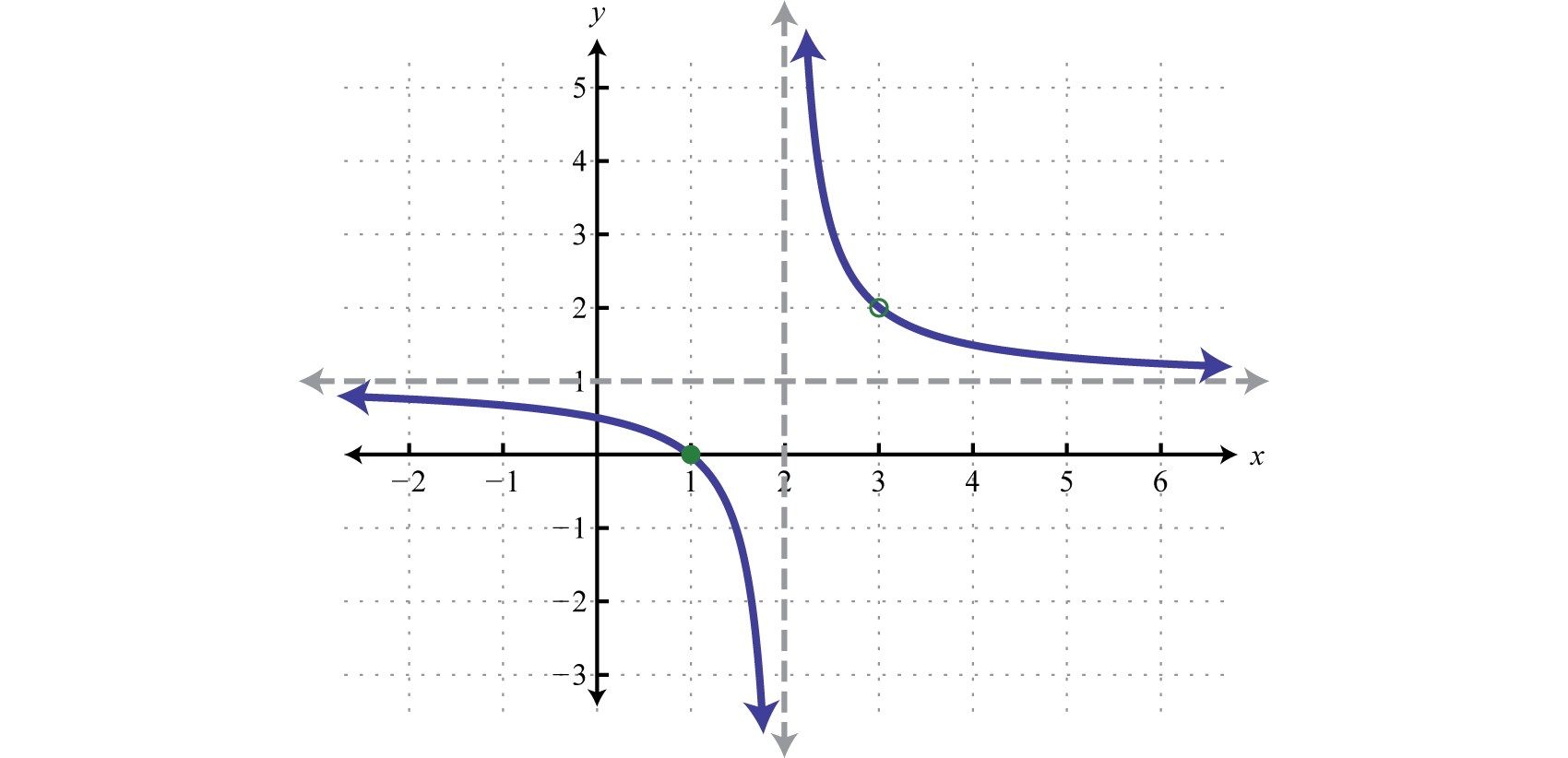
Recall When you find the vertical asymptote of a graph you factor out the original equation that you are given. If anything from the top and bottom cancels out, then what is canceled out is your hole. Moving on, whether something is canceled out or not, whatever is left as your denominator will be set equal to zero in order to find the x=# of the vertical asymptote. Then you set the limit equation. If you do have a hole then you set those factored parts of the original equation set to 0 to find what x equals. From here you plug in the number you got into the equation that remained from your polynomial after everything had been canceled out, and solve. For example: x^3-x/x^3+x^2-2x
when factored it is :
This makes the remaining equation the equation you will refer to when finding the vertical asymptote.
> vertical asymptote: (x+1)/(x+2) *now nothing cancels
> x+2 = 0 * set the denominator to zero
> x=-2 *once solved you get this as the equation for you vertical asymptote.
>hole: x=o *x was canceled out, set it to zero
> x+1=0 *solve ---> x=-1
^ 0 and -1 are you hole x-values so you set it in coordinates as > (0, ?) and (-1,?)
*now in order to solve for the y values you plug in the x values into the remaining equation
> (0+1)/(0+2) = 1/2 so it is now (0 , 1/2)
> (1+1)/(1+2)= 2/3 so it is now (1 , 2/3)
Now on that now, the difference between having a vertical asymptote and a graph having a hole is that a vertical asymptote is basically the line(s) that goes down the graph from top to bottom and crosses the x-axis---> hence it is VERTICAL, where as the holes on the graph are where the graph will not go through and are shown on the graph with open circles.
Monday, September 24, 2012
Unit G Summary Question #5: Crossing of the Asymptotes
5. Describe the conditions in which a graph can cross through an asymptote.
 |
| As you can see, the graphs almost touch the vertical asymptote, but refrain from doing so. Also, the graphs almost cross the MIDDLE of the horizontal asymptote, but the is fine. |
A graph can only cross through certain types of asymptotes. For example, graphs can cross through the middle of the a horizontal or slant asymptote. With that said, it can NEVER cross the ENDS of the asymptote. Moreover, a graph canNOT ever cross a vertical asymptote because then it would have crossed the boundaries and get in the way of the other graph. In fact, the vertical asymptote lines are like the domains and the domains are the bad values of the given equation that don't work therefore, the graphs never touch these vertical asymptotes.
Unit G Summary Question #2: Limit Notation for Horizontal Asymptotes
-->2. Describe what the limit notation for horizontal asymptote actually means.

*BEFORE YOU READ: Be sure to remember the rules that identify whether a graph has a horizontal line. (See blogpost on --> Unit G Summary Question #1:Horizontal Asymptotes)
The limit notation of a horizontal asymptote can be read as: "as x approaches positive infinity, f of x will be a #." The other part of the limit notation is read as: "as x approaches negative infinity, f of x will be a #." Note that the negative infinity is on the left side of the y-axis on the graph and positive infinity is on the right side of the y-axis on the graph. The number that is correlated to the limit notation where I put the number sign will be the number that is your horizontal asymptote. For example, on the photo, my horizontal asymptote was y=0. Thus, when 'x' approaches positive infinity it is 0 and when x approaches negative infinity, the number resulted as f(x) is also 0. The number will be the same on both since it is horizontal and it remains constant going across the graph from left to the right. (left:_______horizontal asymptote_______:right)
Sunday, September 23, 2012
Student Video #1: Unit F. Concept 10
- What is this video about?
This video goes over how Unit F. Concepts 6 &1 0 on how to find the zeroes of a polynomial to the 4th to 5th degrees. There are descriptions of each step which include using the rational roots theorem, Descartes Rule of Signs, using synthetic division to find zero heroes of the polynomial in problem #6 until its a quadratic, and factoring to get the remaining zeroes of the polynomial.
- What does the viewer need to pay special attention to in order to understand the concept?
- Remember that you use synthetic division until your answer row is a quadratic. For this problem, because it is in the 4th degree, you only have to use synthetic division twice CORRECTLY (meaning that the two times you use synthetic division you are left with a Zero Hero!) The video will elaborate more on that.
- Make sure to note that if the polynomial is not factorable then you will have to use the quadratic formula to find the zeroes (which will most likely be imaginary/complex numbers). However for this problem in particular, it is factorable but if you don't like using the grouping method, you could use the quadratic formula if you wanted to.
Unit G Summary Question #3: Slant Asymptote
3. When does a graph have a slant asymptote? How do you find the equation of the slant asymptote?
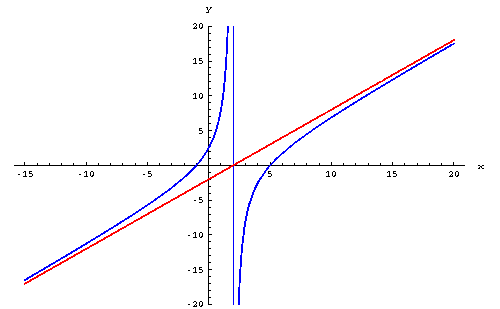 A graph has a slant asymptote ONLY when the degree of the numerator is ONE degree larger when compared to the degree of the exponent of the denominator. For example, 2x^2+4/2x would be applicable as a slant asymptote because the numerator is to the second degree, whereas the denominator is to the first degree (the bottom degree is smaller than the top by one degree). As you can see from the image to the left, the slant asymptote is the red line.
Moreover, the equation of a slant asymptote is: y=mx+b. To find the equation of this particular asymptote you use long division. Afterwards, once you have your answer, everything [other than your remainder] will be the equation of the slant asymptote line. Like the horizontal line, graphs can sometimes cross through a slant asymptote towards the middle of the graph, but NEVER at the ends of it.
Moreover, the equation of a slant asymptote is: y=mx+b. To find the equation of this particular asymptote you use long division. Afterwards, once you have your answer, everything [other than your remainder] will be the equation of the slant asymptote line. Like the horizontal line, graphs can sometimes cross through a slant asymptote towards the middle of the graph, but NEVER at the ends of it.
Unit G Summary Question #1: Horizontal Asymptotes
1. How do we know if a graph has a horizontal asymptote? What are the three options?
Graphs have many parts to them as you can see from the photo to the right. The horizontal asymptote is the line that goes straight across the y-axis(the pink line). You know if a graph has a horizontal asymptote when there is a bigger degree on the bottom which makes the asymptote y=0. If the numerator and denominator have exponents with the same degree, then the asymptote is basically the leading coefficient of the numerator over the leading coefficient of the denominator. On the other hand, there will be a case in which you will NOT have have a horizontal asymptote which is when there is a larger degree of the exponent on top.
Note that graphs can occasionally cross through the middle of a horizontal asymptote; however, NEVER toward the ends of the line (meaning far left or far right). Also, you can only either have a horizontal asymptote or a slant asymptote in a graph, NEVER both.
Saturday, September 15, 2012
Math Insperation Quotes:
http://www.quotegarden.com/math.html
"The essence of mathematics is not to make simple things complicated, but to make complicated things simple." ~S. Gudder
"I never did very well in math - I could never seem to persuade the teacher that I hadn't meant my answers literally. ~Calvin Trillin"
Subscribe to:
Posts (Atom)