Unit G Summary Question #3: Slant Asymptote
3. When does a graph have a slant asymptote? How do you find the equation of the slant asymptote?
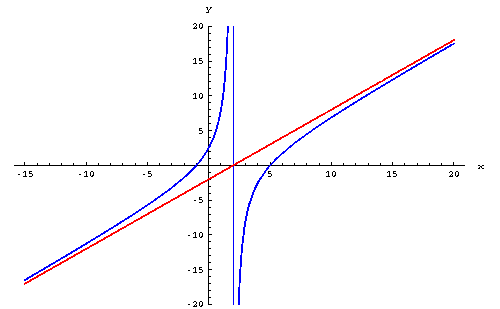
A graph has a slant asymptote ONLY when the degree of the numerator is ONE degree larger when compared to the degree of the exponent of the denominator. For example, 2x^2+4/2x would be applicable as a slant asymptote because the numerator is to the second degree, whereas the denominator is to the first degree (the bottom degree is smaller than the top by one degree). As you can see from the image to the left, the slant asymptote is the red line.
Moreover, the equation of a slant asymptote is: y=mx+b. To find the equation of this particular asymptote you use long division. Afterwards, once you have your answer, everything [other than your remainder] will be the equation of the slant asymptote line. Like the horizontal line, graphs can sometimes cross through a slant asymptote towards the middle of the graph, but NEVER at the ends of it.

No comments:
Post a Comment