Thursday, September 27, 2012

Unit G Summary Question #10: Rang of a Rational Function.....

10. While the domain of a rational function depends on DIVAH, what do you think the range of a rational function depends on. Give an example.

NOTE: D-omain
               I-s the
              V-ertical
              A-asymptote & the
              H-ole
I believe that range of a rational function is dependent upon all of the y-values that belong to the x-values that come from the vertical asymptotes and holes. For example, the vertical asyptotes for a graph were to be x=-2 and x=2 and the hole would be x=1. This would make the  the domain, or the bad values, -2,2, and 1. With that, the range would be the infinite numbers that these numbers passed from +infinity (the + numbers of the y-axis) and - infinity (the - numbers of the y-axis). Because the lines run vertically downwards, the coordinate pairs would be something like (-2,4), (-2,3), (-2,2) ,(-2,1) ,(-2,0) ,(-2,-1) ,(-2,-2), (-2,-3) and so on upwards and down the y-axis, with the domain staying the same. This would be the same for the x=2 vertical asymptote. In short, the range would be ALL REAL NUMBERS. With that, the range of a hole would simply be the y-value. For exapmle, the hole would have the cordinates of (1, -1/2), -1/2 would be the range.


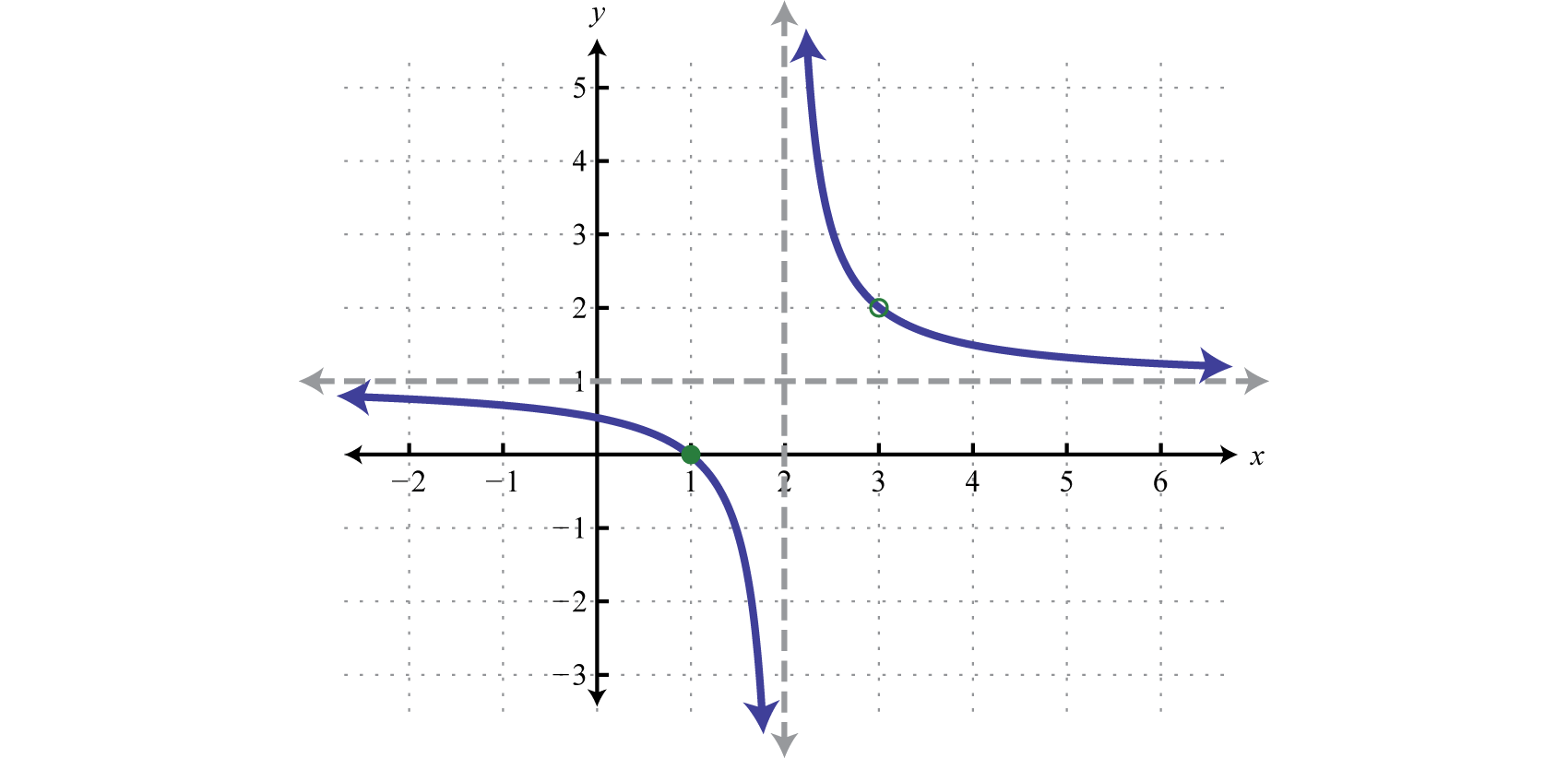
As you can see in this image, the vertical asymptote is
x=-1. The range, or y-values, run up and down make it
ALL REAL NUMBERS.


On the other hand, if the y-value was a horizontal asymptote, the line would run straight across the y-axis and so it would NOT be all real numbers. For example, if y=2, the y-value would remain constant whereas you x-value would be constantly changing as you traveled across the graph from left to right. [(1,2),(2,2),(3,2),(4,2),(5,2), etc.,...] thus, the range of a horizontal asymptote would simply be the value of y. We have already been taking notice of this and it is noted in our limit notation. (If needed: Review the lesson in Unit G Summary Question #2).


Unit G SUmmary Question # 9: X-Intercepts of a Rational Function

9. Describe how to find the x-intercepts of a rational function. Include both the long way and the shortcut way, explaining why the shortcut makes mathematical sense.

How to: The LOOOOONG WAY....
In order to find the x-intercepts through the use of the faster method, it is important that you know how we got to that point and why.
To make it easier, lets use an example: 3x+3/x^2-4
     ^* REMEBER TO FACTOR!--->  3(x+1)/(x+2)(x-2)
       * now we get to the fun part..... x-intercepts!!! :D
       First: set the y [or f(x) ] to zero, thus setting the equation to zero
                                    ^   0= 3(x+1)/(x+2)(x-2)
     
       Second: Mulitply both sides by the denominator
                                  ^   (x+2)(x-2) 0=3(x+1)/(x+2)(x-2)    x    (x+2)(x-2)
     
       Third: As you can see, the denominator cancels out on the right side
                                 ^ (x+2)(x-2) 0=3(x+1)/(x+2)(x-2)    x    (x+2)(x-2)

                                               * now you are left with ....
                                                   (x+2)(x-2) 0=3(x+1)
       
         Fourth: as you can see, the (x+2)(x-2) will be eliminate becauseANYTHING                 multiplied by zeor will turn to...... zero!

         Fifth: Now you have:
                                                          0=3(x+1)
     
          Sixth: divide by 3:
                                                          0=3(x+1)
                                                          3       3

       Seventh: solve like you normally would.... in this case subtract 1 to both sides
                                                          0-1=x+1 -1
 
      Eighth!!! And your x-intercept is....      x=-1  making it (-1,0)


How to: SHORT WAY...
Phew! Now that you know how to do it the long way, the shorcut will make a lot of sense! :)


          First: set the y [or f(x) ] to zero, thus setting the equation to zero
                                             ^   0= 3(x+1)/(x+2)(x-2)

         Second: since you know that the denominator will always cancel and be eliminated you can keep on moving forward. SIGH OF RELIEF....
                                                      0= 3(x+1)/(x+2)(x-2)

         Third: You are left with...
                                                       0=3(x+1)
       
          Fourth: divide by 3:
                                                          0=3(x+1)
                                                          3       3

      Fifth: solve like you normally would.... in this case subtract 1 to both sides
                                                          0-1=x+1 -1
   
      Sixth!!! And your x-intercept is....      x=-1  making it (-1,0)


Unit G Summary Question #6: Plotting Holes

6. How do we find the appropriate place to plot a hole if the y-value is undefined when plugged into the original equation?

NOTE: If you need to review how to find a hole, refer to Unit G Summary Question #4 :)
            * Hopefully you noted that you only have a hole if the something that was the same on the top    and bottom was canceled.
            * Holes are in place of a regular point due to the fact that the denominator (value on the bottom of the fraction) cannot be equal to zero.
Notice how the hole is like a break in the graph, but the
graph continues after skipping the spot where the hole
was plotted. As a result, the whole is NOT included
within your answer. It also acts as a bad value thus it is
annotated in your domain of a graph.
After finding the x-value of the hole from the original equation and you plug it back into the original equation, you will get the answer as being undefined. In order to find the y-value CORRECTLY, you will have to plug that x-value into wherever the 'x' shows up in your simplified equation. This will give you your y-value and thus your coordinates of the hole. When finding the y-value of the hole, if it is undefined then that basically means that the hole is NOT included within your answer. When plotting the hole, make sure that you do so with an OPEN circle -∘- (not a just a regular point ⋅). 

Tuesday, September 25, 2012

Unit G Summary Question #8: Y-Intercepts

8. How do you find the y-intercept of a rational function? Does this need to be done in the original or simplified equation?

When finding the y-intercept of a rational function you simply plug in zeroes in the equation wherever there would normally be an 'x'. Froms here you solve normally. For example, if the equation was y= x^2+3x+/3x+1 you would plug in the 0's so that it would look like
y=(0)^2+3(0)+1/3(0)+1---> y=1/1 or y=1, thus the y-intercept would be (0,1).
You MUST note that if your graph did have holes and you canceled things out from the top and bottom (if you need review refer to Unit G Summary Question #4) it is mandatory that in order to find the y-intercept that you use the simplified/remaining equation.
Also, remember that a graph of a rational function can only have ONE y-intercept or NONE, but never more than one!

Unit G Summary Question #7: Vertical Asymptote Limit Notation

#7: Describe how to write the limit notation for vertical asymptotes and what the notation means.

Once you have found the vertical asymptote(s) [go back to Unit G Summary Question #4], you include those values in your limit notation. Make sure to graph the equation on your graphing calculator and because you will be using it to find the notation.

PLEASE NOTE: - sign on the right of the number means it is to the left of the vertical asymptote [ex. 2-] it does NOT mean its a negative, if it were if would look like -2 -. A + sign on the right of the number means it is on the right of the vertical asymptote. [ex. 2+] Also, recall that a + ∞ symbol means that the graph is going upwards and that a - ∞ symbol means that the graph is going downwards.

Lets use this picture as an example. As you can see, the vertical asymptotes are located where x=-1 and where x=1. Now you look the the left of the -1 vertical asymptote line and you see that the graph is going upwards. This is notated as follows: as x--> -1-, f(x)--> +∞. Next look at how to the right of the 
-1 vertical asymptote line the graph goes down and so it is notated as : as x--> -1+, f(x)--> -∞. Let's move onto the asymptote line of x=1. To the left of this line the graph is going down and so it is written as: as x--> 1-, f(x)--> -∞. Finally, we look to the right of this line and we see that the graph goes upwards there fore it is written as : as x--> 1+, f(x)--> +∞

Unit G Summary Question #4: Vertical Asymptotes VS. Holes

4. What is the difference between a graph having a vertical asymptote and a graph having a hole?

Recall  When you find the vertical asymptote of a graph you factor out the original equation that you are given. If anything from the top and bottom cancels out, then what is canceled out is your hole. Moving on, whether something is canceled out or not, whatever is left as your denominator will be set equal to zero in order to find the x=# of the vertical asymptote. Then you set the limit equation. If you do have a hole then you set those factored parts of the original equation set to 0 to find what x equals. From here you plug in the number you got into the equation that remained from your polynomial after everything had been canceled out, and solve. For example: x^3-x/x^3+x^2-2x 
when factored it is : x(x+1)(x-1)/x(x+2)(x-1)   * the 'x' and the '(x-1)' canceled out making those our holes
This makes the remaining equation the equation you will refer to when finding the vertical asymptote.
     > vertical asymptote: (x+1)/(x+2)    *now nothing cancels
                               >      x+2 = 0          * set the denominator to zero
                               >      x=-2               *once solved you get this as the equation for you vertical       asymptote.

     >hole:  x=o     *x was canceled out, set it to zero

           >  x+1=0     *solve    ---> x=-1
          ^ 0 and -1 are you hole x-values so you set it in coordinates as    >   (0, ?) and (-1,?)
          *now in order to solve for the y values you plug in the x values into the remaining equation
         > (0+1)/(0+2) = 1/2  so it is now (0 , 1/2)
         > (1+1)/(1+2)= 2/3 so it is now (1 , 2/3)

Now on that now, the difference between having a vertical asymptote and a graph having a hole is that a vertical asymptote is basically the line(s) that goes down the graph from top to bottom and crosses the x-axis---> hence it is VERTICAL, where as the holes on the graph are where the graph will not go through and are shown on the graph with open circles.

Monday, September 24, 2012

Unit G Summary Question #5: Crossing of the Asymptotes

5. Describe the conditions in which a graph can cross through an asymptote.

As you can see, the graphs almost touch
the vertical asymptote, but refrain from doing  
so. Also, the graphs almost cross the MIDDLE
of the horizontal asymptote, but the is fine.
A graph can only cross through certain types of asymptotes. For example, graphs can cross through the middle of the a horizontal or slant asymptote. With that said, it can NEVER cross the ENDS of the asymptote. Moreover, a graph canNOT ever cross a vertical asymptote because then it would have crossed the boundaries and get in the way of the other graph. In fact, the vertical asymptote lines are like the domains and the domains are the bad values of the given equation that don't work therefore, the graphs never touch these vertical asymptotes.