- What is the mathematical definition of this conic section and how does that definition play a role in the properties of the conic section and how it is shaped or formed?
An ellipse is formed when as you go around the ellipse the distance from the 2 foci and a point on the figure summed together will always be the exact same number. That definition plays a role in the properties of how it is formed because the doulbe napped cone is intersected by a plane at a slanted horizontal angle. This intersection only effects one of the double-napped cones,NOT both.

- How does the focus (or foci) affect the shape of the conic section?
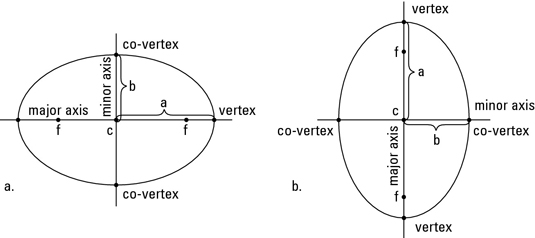
The foci run along the major axis of the ellipse. If the 'a' [bigger number] is under the (x-h)^2 than it will be wide, but if the 'a' is the denominator of the (y-k)^2 than it will be long. The foci determine how fat or skinny they are. If the value of the foci is LARGE, than the ellipse will be FAT, but if its value is small than it will be skinny.
- How do the properties of this conic section apply in real life?
In astronomy, according to Kepler's First Law: "The planets orbit the Sun in ellipses with the Sun at one focus (the other focus is empty)." Planets orbit in an elliptical manner because of the gravitational interactions between planets and the Sun, as well as with other celestial bodies.
***For more about ellipses info, check out: http://www.keplersdiscovery.com/Elipse.html***
Elliptical machines are another example of ellipses in real life. The shape of moving your legs rapidy in an elliptical motion rather then circular allows your legs to push farther and elongate yourself a bit more which adds to the intensity of the workout.
IMAGES CITATION:
-http://www.nhn.ou.edu/~jeffery/astro/ellipse/ellipse_001.png
-http://staff.argyll.epsb.ca/jreed/math30p/conics/images/Image_S1_L01_007.jpg
-http://forums.autodesk.com/autodesk/attachments/autodesk/43/65030/1/ellipse.gif
-http://media.wiley.com/Lux/94/219994.image1.jpg
-http://www.freewebs.com/mdreyes3/SEASONS.jpg
-http://www.paganprincesses.com/wp-content/uploads/2010/12/Earth-Orbit3.gif
-http://ellipticalandtreadmillreview.com/wp-content/uploads/2011/06/NordicTrack-AudioStrider-990x500pxl.jpg